

Fugitive delights
on brush piles, fleeting colors, rescue blooms

I told you I’m always thinking about trees. How much I love them, how much I’m hurting for the ones in Nashville. How they will remind us. How I know they’ll nevertheless keep going, keep growing. They’ll continue cycling through the seasons, no matter their broken limbs and lost branches. I wonder if they feel the severing. Do they feel a pull from the ground where pieces of themselves lay, where their fallen friends lay in neat-chaotic death? Do those who remain standing miss those who are lost; do they grieve their phantom limbs, branches, leaves, buds not yet burst—some of this so close by, no longer held aloft but brought down to earth? We know trees talk to one another; are they talking about this?
Do the birds and other wildlife who gravitate to the brush piles investigate these tangles of branches as alien-new or familiar-comfortable spaces? Do they wonder why their habitat has suddenly reframed itself in this way? Is their attraction to a brush pile different from their attraction to the canopy?
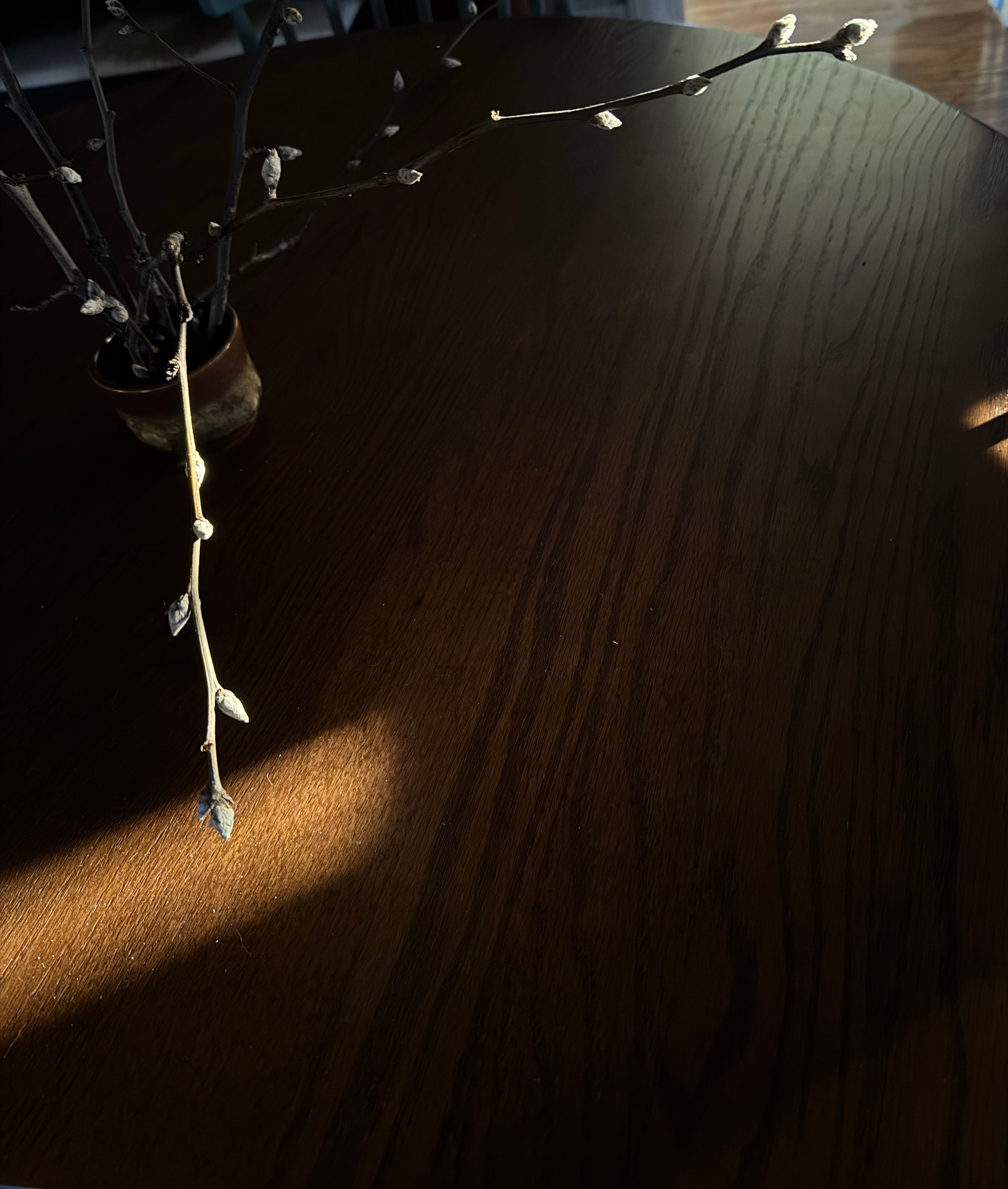
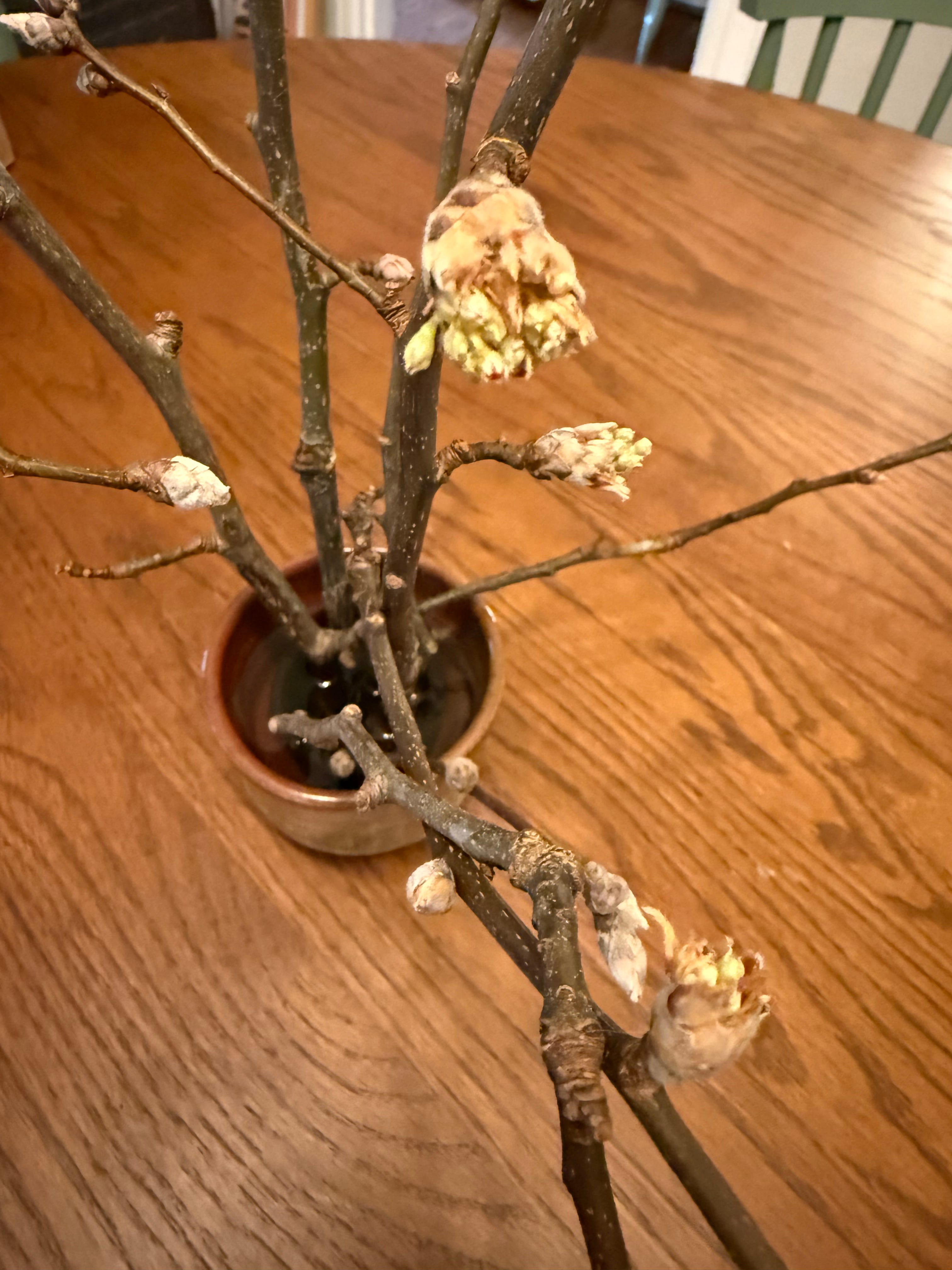
This past week I snapped a few budded branches off a limb in one pile on 16th Street, clipped a few small pussy willow twigs off another on Chapel Ave. I did this at the encouragement of Joanna Brichetto, who said it might work, should one come across a budded branch, to force the buds to open indoors. After the first three or four days I thought it wasn’t working for me and my buds, nothing changed. But a few days ago, tiny, barely-noticeable spikes appeared where once was smooth-tipped bud, and today these have expanded into bubbly masses of tiny, not-yet-unfurled blossoms. In another day there may be full-on flowers.
A few weeks post-storm, Nashville’s streets and sidewalks and front yards are speckled gratuitously with brush piles of all shapes and sizes, comprised of all kinds of trees, magnolia, maple, redbud, pear. Several parks remain closed due to the degree of tree damage. The sight of the many brush piles should elicit pain, the lingering throb of the storm’s impact, the wince of memory—but the strange thing is, I find the piles oddly beautiful.
I’ve felt drawn to the copious brush piles like a bird myself. I find them oddly beautiful in their sprawling, prickly shapes so full of bending lines and zigs and zags and circles and pockets of emptiness and tangled mystery. They are made of the same stuff as trees, but the shape is something entirely new, different, almost aquatic. One really did resemble a big fish. No two are the same. They are fingerprint-like, even, in their complexity and fine lines.
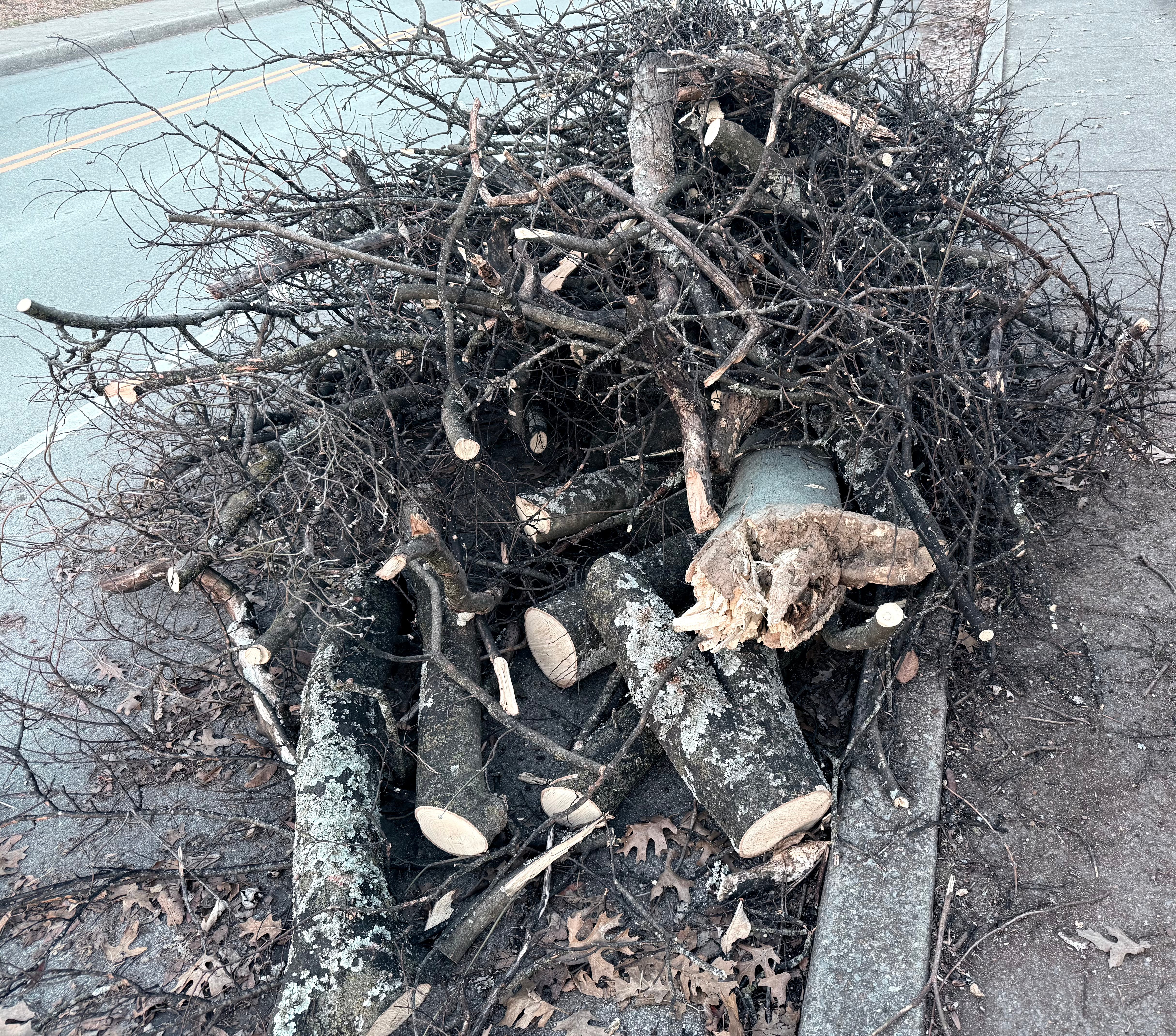
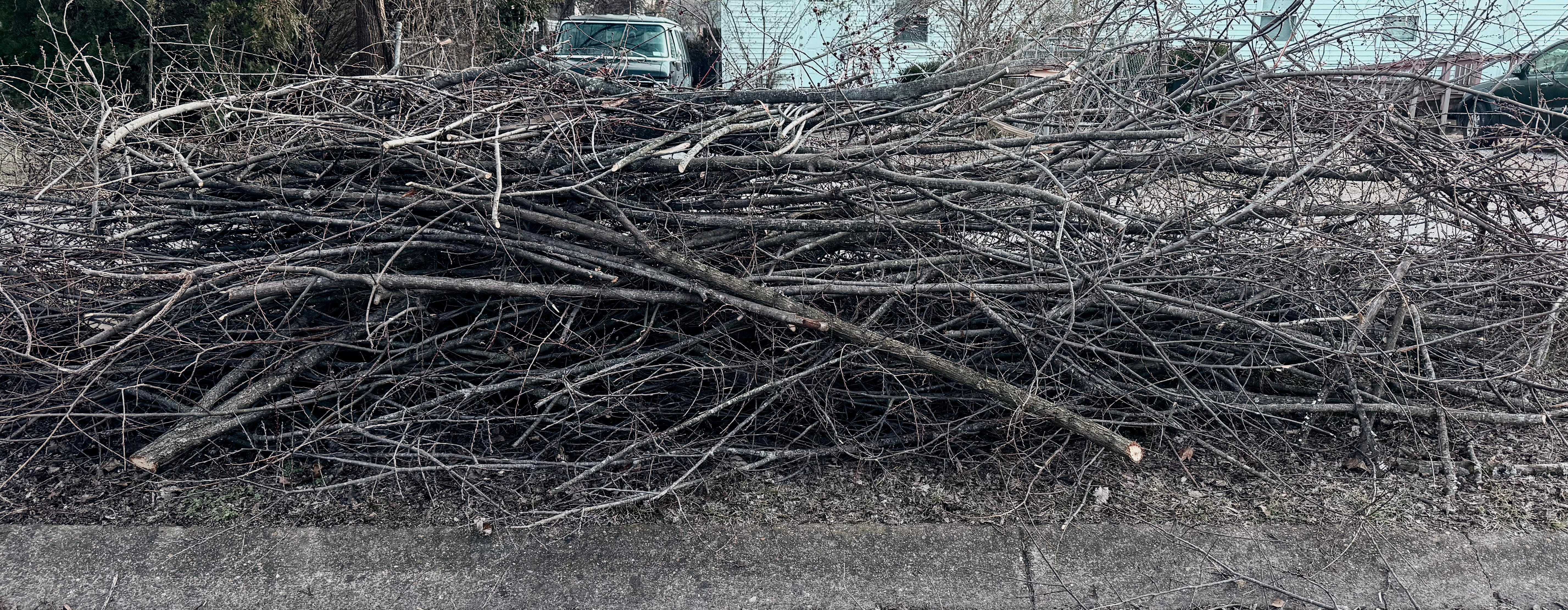
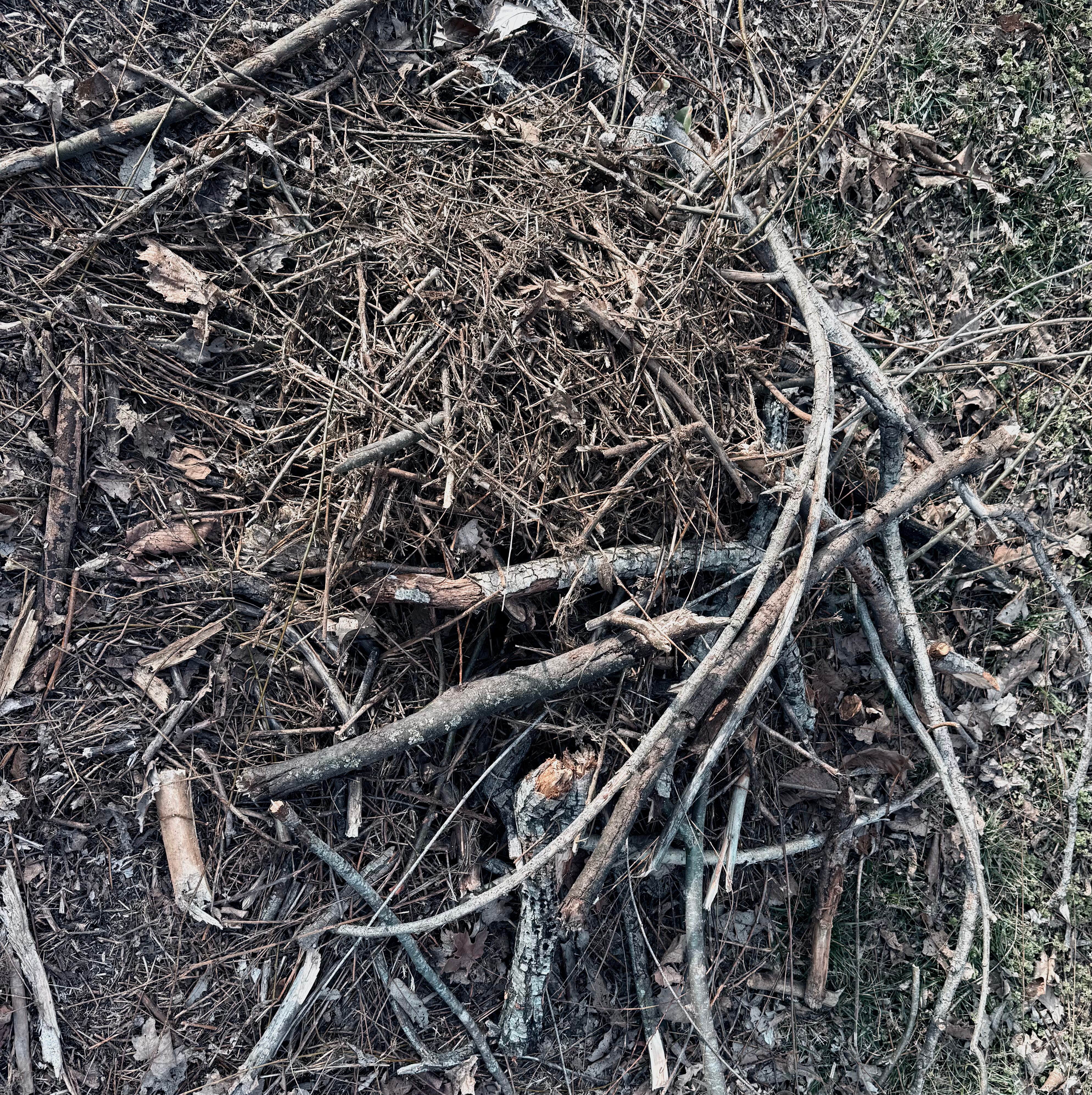
Lately, I wish I could crawl inside one of these brush piles, make one my hideout, as might a bird or a squirrel. A brush pile of the mind, a place to secret myself into, to disappear into for a short time. My mind is the brush pile, a wild and messy thicket of a place that also represents an attempt at organization, grouping a mass of like things together so they are not scattered, so they may be gathered by those tasked with the gathering. Within some brush piles there are even orderly sections comprised of stacked limbs sizeable enough to count as firewood. Circles and cylindricals. In others it’s a deep green mass of leaves or needles. Each brush pile is unique. I can’t stop checking them out. Order, disorder. A drone might perceive them as freckles or moles all over the city body. From my earthbound vantage point they also remind me of fantastically giant tumbleweeds. (Some are probably the size of real-life tumbleweeds.)
I was delighted to learn a new phrase this week from a newsletter in which Kristen Drozdowski, writing about turning flower petals into dye, taught me about fugitive colors, meaning those that are not lightfast. In other words, fleeting, to be used sparingly, perhaps, in painting, for their ephemerality.
The colors in a rose petal are in the family of anthocyanins: water soluble, pH sensitive, color changing, antioxidant, sappy medicine for the body and the soul. Usually in the red, blue, purple range. This kind of color is delicate, fugitive, with a propensity to disappear. It’s why we adore it, and adorn ourselves with it. Like most things, the vibrancy won’t last a lifetime, but it can be extracted, especially from the freshest, pranic petals, like these.
Fugitive as ephemeral! A color as something that can escape! Of course colors escape, they fade and morph all the time, but I never in all my years heard “fugitive” used to describe a color, a pigment. Other things can be fugitive.
Fugitive brush piles, fugitive love, fugitive obsession. Fugitive light, fugitive attention.
In their fugitive state, Nashville’s brush piles present an opportunity for the production of place-based, temporary, site-specific art. They’re widespread and similar in that they exist, for this brief time, all over the city; but each one is unique.
Picture them painted wild, bright colors, or garlanded with tissue paper blossoms, or adorned with messages of condolence and support from us to the trees that gave them up, or messages of love and light to each other. Picture them tied with a flurry of grosgrain bows, (fugitive) red and pink and white for Valentine’s, or (fugitive) purple and green and yellow for Mardi Gras.
I’d like to do something of this nature. I have not. Probably won’t. What I have done is take many pictures of the brush piles. I could do something with these photos, and I still might, but anything I could do would be far less spectacular than modifying or adorning the brush piles themselves.
We also have a fresh crop of snags. You have to love a snag. A death that is no death; a death that supports life, like any fallen tree in a forest, but with more visibility. We had a hackberry snag in our backyard for years, after that tree fell in a December storm, and I loved watching it become its own small ecosystem. One year, by the time it was little more than a shallow but distinct bowl softening into the surrounding earth, where we planted lamb’s ear.
Here is David Haskell on the mindblowing magic of bacteria in tree bark.
And here is Rilke, whose Letters to a Young Poet I’ve been reading:
Being an artist means, not reckoning and counting, but ripening like the tree which does not force its sap and stands confident in the storms of spring without the fear that after them may come no summer.
Songs for the week! (Songs FTW)
Thanks for reading, listening, comin’ along. If you enjoyed this field trip, please consider tapping the ❤️ button, or share it. Or both! 🤘
Fugitive colors! Thanks for bringing this to my attention! Also, I need to reread that Rilke.
Oh, how I love this…this lovely ode to trees. How imaginative. I feel slight shame that I haven’t thought of the piles this way. Normally, I’d be one thinking imaginatively of them. At least examining them and finding wonder in them.
I guess I haven’t examined them up close—only driving by and seeing them lined up— wincing at their pain, gawking at their splintering breaks. Taking in their damage.
I think this I my favorite Field Trip post. It illustrates what a talented writer you are, what an observer of nature, how imaginative, and able to express yourself in various artistic ways.