

What a difference two weeks makes - or doesn't
I'm sticking with metallic gold paint for a while

On Saturday, January 24th, curled under a blanket on the couch by the gas fireplace, I seriously considered pulling the plug snuffing the flame on FIELD TRIP.
Snow was falling. Alex Pretti had just been murdered. The Greenland/Davos debacle was still simmering. (Remember that?) At least half my country was reeling. Of what use, I asked my couch-bound self, was my little delight-forward newsletter, given how bad things have gotten? I was seized by the urgency of the moment, but the call to respond came shackled to a certainty that I had absolutely nothing to say to the horrors that someone else couldn’t say much more effectively. So why raise my voice, add to the noise? Why not let them say it?
The next day, Winter Storm Fern1 hit Nashville and devastated the city, leaving hundreds of thousands without power in sub-freezing weather for days on end. (Fourteen days later, some still don’t have electricity.) Our canopy took a massive hit. Thousands of trees fell or split and splintered, leaving the blond wood beneath the bark exposed in jagged open wounds. On the first morning after the storm, we listened to loud pops and cracks and crashes and booms for hours, unsure if what we were hearing was falling trees or exploding transformers. This past week, the sound of the city’s slow recovery has been the snarl of chainsaws.
I started this draft last weekend, on February 1, a week after the storm hit. Hence the self-aware strikethrough on “pulling the plug,” which felt not only cliché but too ironically close to home. That morning, my parents were on day eight without power and refusing to leave their home. That afternoon, pushed to the brink, they gave in and came to stay with me. They’re back home now, with power restored on day 11, but the experience took a toll on them. All over the city, the sight of broken trees and piles of cut limbs presents a disturbing visual metaphor for how the world feels now.
So now, one more week post-storm, I’m finally finding my way back to these words, and once again, I’m struggling to locate the point. I’ve had a lot on my mind. I know you have, too. Nerves are frayed. Things have been bad in Nashville. Things have been bad in this country. (Unless, I suppose, you’re a Republican/MAGA living in a different reality than I. What a gas that must be for you. 🙄 But who am I kidding; you’re not reading this newsletter.)
I’ve put aside the idea of “snuffing the flame,” at least for the moment. I’m back to feeling like there’s a place for FIELD TRIP, at least in that it is a meaningful act for me, an AI-free space, a place to center a mind that’s proven itself, lately, too eager to careen into fear and anxiety and imagining awful scenarios. A place to celebrate expressions of art and beauty, each of which assure met hat we have to keep looking at and celebrating such aspects of life—such lights—in the midst of deep darkness. The sharing of light is this newsletter’s molten core.
“Thank god for art—poems & books & films & music—in a broken world. It’s the gold that fills the cracks,” Maggie Smith posted a week ago, the day I started writing this.
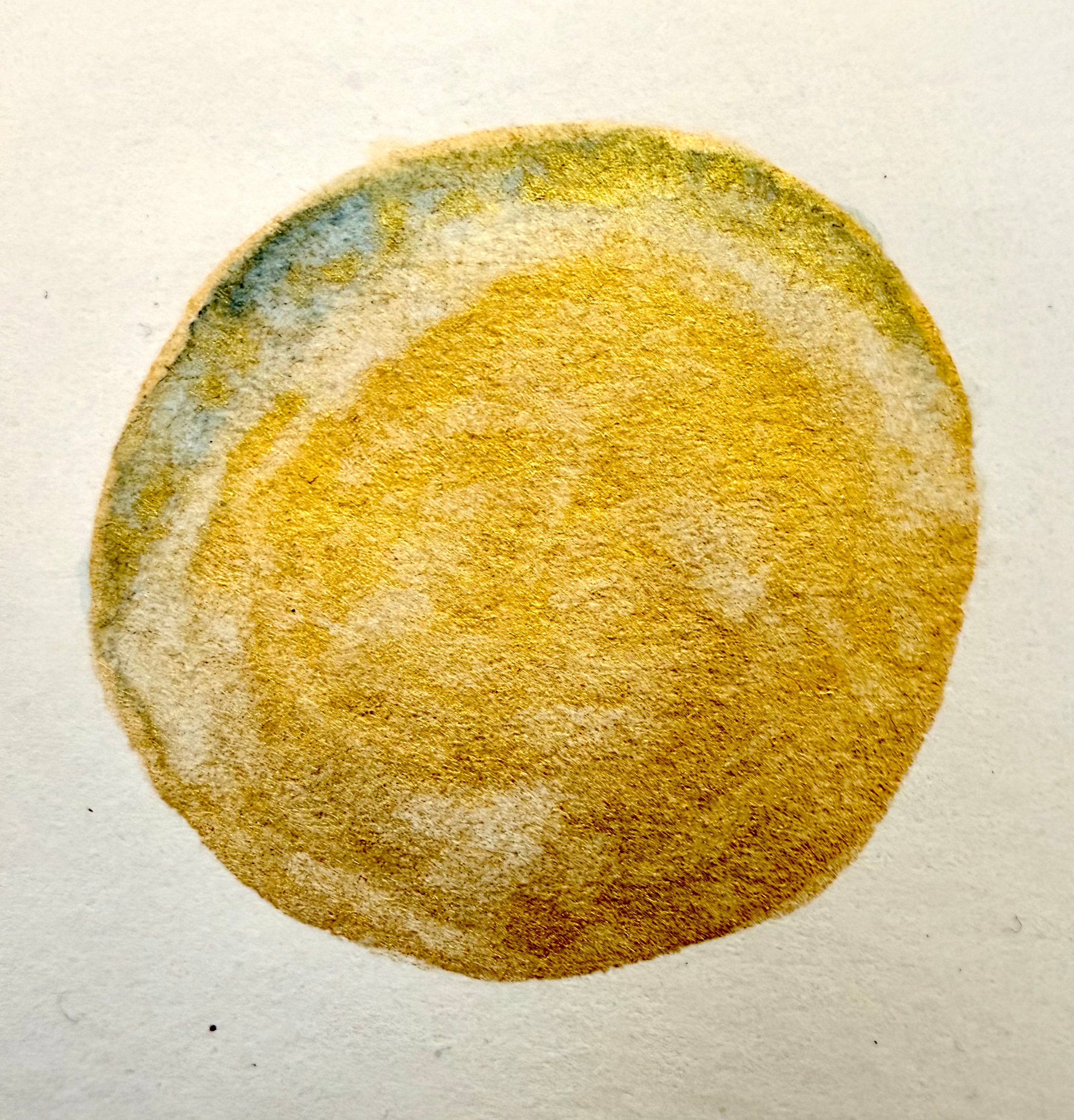
I continue to think about how I might write resistance in a way that works for me. I feel my voice stiffen unappealingly when I try to write toward the emergencies of our national and global climate, the growing threats to democracy. I sound like a scold, a lot like I do IRL when I’m haranguing the teenager about cleaning her car or using the dining table as a dumping ground. There’s a tightening and souring of tone I seem unable to avoid, and it doesn’t do my message any favors. To the contrary, my writing shines when it’s infused with joy, a sense of the carefree, a bit of humor (at least I amuse myself!). But (and here I am talking to myself) while that’s all well and good, the game done changed, and you simply must write in the broader context of your country in crisis. You must acknowledge what’s happening “out there”/”to us all” and speak directly to dire reality. No more la-la-la beauty, la-la-la delight, I mean I never meant it that way in the first place!—but what’s implied in my brain may not radiate on the page unless I use the big bright loud metallic gold paint. So I’m using it. And not just figuratively. I’ve been messing around with actual gold paint, watercoloring circles. This feels soothing right now.
We truly must keep raising our voices against authoritarianism and state terror. We must also keep supporting and publicizing efforts to prepare and support our natural and built worlds for continuing climate-change-driven disasters. Dead prose, this? Yeah. So listen to others—Margaret Renkl, Tressie McMillan Cottom, M. Gessen, Kiese Laymon for starters (tell me your favorites?)—for eloquent fuel for your flame. Read, read, effing read!
And…maybe try memorizing a poem?
The idea of memorizing and reciting poetry has been all over my inbox lately. First, thee Rebecca Gayle Howell:

Then my friend and Belmont University professor Bonnie Smith Whitehouse in her forthcoming IN OUR HANDS: A MAKER’S MANIFESTO FOR CHANGING THE WORLD THROUGH CREATIVE PRACTICES: “As an undergraduate English major, I was required to memorize [lines from an Edmund Spenser sonnet cycle] in a Renaissance literature class. I most likely groaned when my professor issued this assignment, but now, more than thirty years later, I am glad she did. Ever since, they have been imprinted on my heart. Penelope’s audacity as a maker has always struck me as deliciously subversive, and it’s her example that in part led to my own subversive arts practices.”
And then Lane Scott Jones:

And then Nancy Rawlinson, with this entire Substack devoted to memorizing poetry:

I’m pretty sure I’ve seen at least a couple other entreaties, too. The universe be bellowing: MEMORIZE SOME LINEZ!
I was planning to linger here, to give more reflection to the restorative act of memorizing poetry, but I think I’ll come back to this in a future FIELD TRIP. (Related: Should The Porch offer some kind of gathering where we work on memorizing a poem, like students of yore doing their recitations?! And/or should The Porch create a program for book reviews/criticism? That’s been on my mind the past few days, for more terrible, obvious reasons.)
–Also to come: More thinking about trees. I am almost always thinking about trees, and that has been extra true the past two weeks. I was happy to see on of my favorite trees, the American Elm across the street from my yoga studio, this morning. She bore evidence of some snapped branches for sure, but looked mostly OK, tall and strong. I love her so.
P.S. In the interest of celebrating art and artists, another FT—a GSW Q&A—will come atcha quick, as in tomorrow!
Songs for the week! (Songs FTW)
I have been wanting to share these songs for two weeks. Right before the ice storm, I got an old José Gonzalez song, “How Low,” stuck in my head and had to revisit In Our Nature, from 2007, on which it’s the opener. “How Low” has continued to haunt me, seeming to understand that it speaks to the moment. I hope you like it and find it as powerful as I do.
How low are you willing to go
Before you reach all your selfish goals
Punch line after punch line
Leaving us sore, leaving us sore
Absorbed in your ill hustling
You're feeding a monster, just feeding your monster
Invasion after invasion
This means war, this means war
Someday you'll be up to your knees
In the shit you seed
All the gullible that you mislead
Won't be up for it
Where to will you relocate
Now that it's war, now that it's war
And another excellent one from In Our Nature (the whole album is a 10/10):
Gonzalez has a new album out in March (!!), Against the Dying of the Light, and of the eponymous first single, he says:
“It’s a song reflecting on humanity in 2025; about accepting who we are and what led us here, since the past can’t be changed. Then about refocusing our attention on the challenges ahead, like perverse incentives and algorithms that aren’t in line with human flourishing.
And even though we have enormous opportunities with new technology that can eventually design and copy itself, we don’t have to build it right away if it has the potential to make us obsolete. We can rebel against these replicators, rebel against the dying of the light. . . Against The Dying Of The Light is a reflection on how we create hurdles to human flourishing by clinging stubbornly to dogmatic ideologies where people follow dudes who pretend to know shit they don’t know.
These are songs about how we can navigate humanity towards flourishing on an individual and a collective level. They can be listened to just for the sounds, harmonies, and rhythms, but the lyrics are meant to inspire people to engage and take action by collaborating to solve collective problems.”
Thanks for reading, listening, comin’ along. If you enjoyed this field trip, please consider tapping the ❤️ button, or share it. Or both! 🤘
how dare such a destructive storm be named FERN, as in one of the most wonderful forms of life to exist on this planet. Insult to injury.
Loved this post. Wishing the America Elm another healthy hundred years, and inspired to start memorizing. As for the criticism workshop: yes! a million times yes!
Keep writing joy, spotlighting beauty. We have too much of the other, It’s stopping to remember and breathe in what’s good that helps us keep going!